What to do when you miss a day

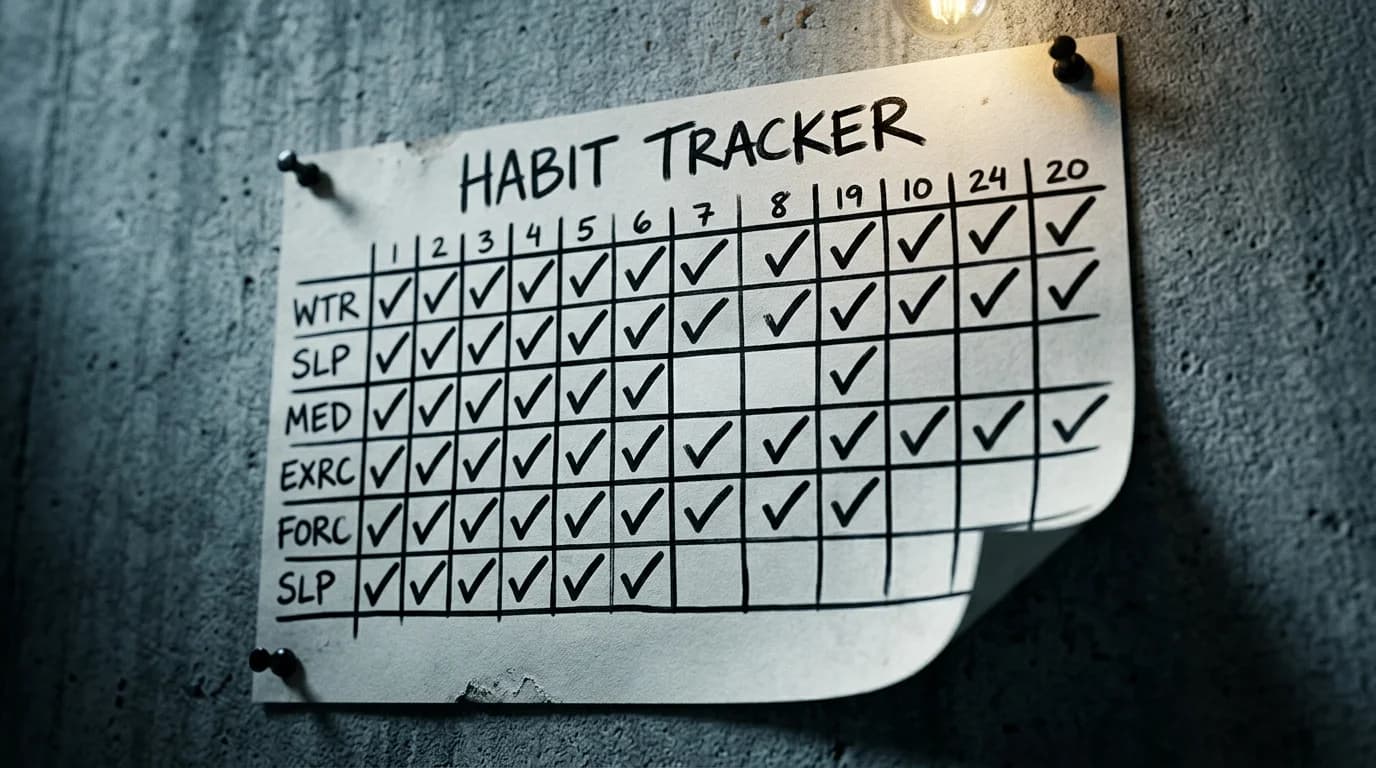
It happens somewhere between day 8 and day 14 for almost everyone. A day goes wrong — a work crisis, a birthday, a night of four hours' sleep — and by bedtime the training didn't happen, the calories are well past the target and none of the six boxes got ticked.
The day itself is trivial. What people do the next morning is what decides the month, and the three most common responses are all wrong.
What a missed day actually costs
Six ticks out of the 180 the program contains. That's a little over three per cent of your compliance score, and roughly nothing in energy terms — one heavy day sits on top of twenty-nine others and gets absorbed by the average within the week.
Your seven-day weight average will bump for two or three days, mostly from sodium and carbohydrate pulling water in. That bump is not fat and it will leave on its own. If you'd like to see the arithmetic rather than take it on trust, look at your progress page after four days.
Even the training miss is smaller than it feels. One skipped session out of a month of them changes almost nothing about what your muscle does over thirty days. Three skipped in a row is a different conversation, and that's the line worth watching rather than any single evening.
The three wrong responses
Each of these turns a three per cent problem into a month-shaped one. They're all versions of the same mistake: treating a missed day as a debt that has to be paid rather than a data point that's already priced in.
- Doubling up — two sessions tomorrow costs you recovery and usually a third day, and no session repays a calorie surplus anyway
- Cutting tomorrow's calories to compensate — a sharper deficit on the day after a hard day is how a good week turns into a binge cycle
- Restarting the program from day 1 — you didn't lose the ten days you already did, and restarting is the single most reliable way to never finish anything
- Earning it back with a punishment walk at 10pm — it buys a few hundred calories and costs you the sleep target, which is a bad trade
The recovery rule
It fits in one line: the next meal is on plan, the next scheduled session is the next scheduled session, and nothing gets added.
Not the next day. The next meal. That distinction matters, because it means the recovery starts within a few hours instead of tomorrow morning, which removes the whole afternoon of write-off eating that usually follows a bad start. Then you pick up the plan exactly where it says to — day 12 does day 12's session, not day 11's.
The missed session isn't rescheduled and it isn't made up. The phases are built as ten-day blocks with a progression written into them, so inserting yesterday's work into today's slot doesn't restore anything — it just makes today's session worse and tomorrow's harder than it was designed to be.
Why the program can absorb it
The design assumption is that you will miss days. Thirty days of six targets is 180 opportunities, and a result at day 30 comes from a high average, not a perfect one — high eighties is a good month and comfortably contains three bad days.
Which is why the dashboard shows a compliance percentage next to your streak. The streak is the motivator and it will break at some point. The percentage is the truth, and it barely flinches. Behaviour-change research is consistent that the lapse is normal and the interpretation of the lapse is what predicts whether people carry on.
So look at the number after a bad day, deliberately. Seeing 91 per cent where you expected a wreck does more for the next morning than any amount of resolve, and unlike resolve it happens to be accurate.
“One missed day is a rounding error. The week you spend punishing yourself for it is not.”
When it isn't one day
Three misses in a fortnight is noise. Three misses a week, every week, is information — and it's almost always one specific target and one specific circumstance rather than a general failure of will. Look at which box goes unticked and on which days before you conclude anything about yourself.
The usual answers are dull and fixable: the session was scheduled at a time that never survives contact with your week, or the calorie target keeps breaking on the same evening. Move the session. Change the meal. If food or exercise has started to feel compulsive or genuinely distressing, that's worth raising with a clinician rather than solving with a stricter plan.
Fix the circumstance and the misses usually stop without any change in discipline. A plan that fits the week you actually have beats a better plan that fits a week you keep failing to arrange, and thirty days is far too short to spend arguing with your own diary.
Sources
Written by Coach D — the voice of the certified personal trainers behind the SHRED30 system. Educational content, not medical or dietary advice.
Day 1 is free.
Go deeper: the free anatomy nutrition and strength & conditioning study guides teach the science under every article.