The compliance score: why 87% beats 100% then quitting
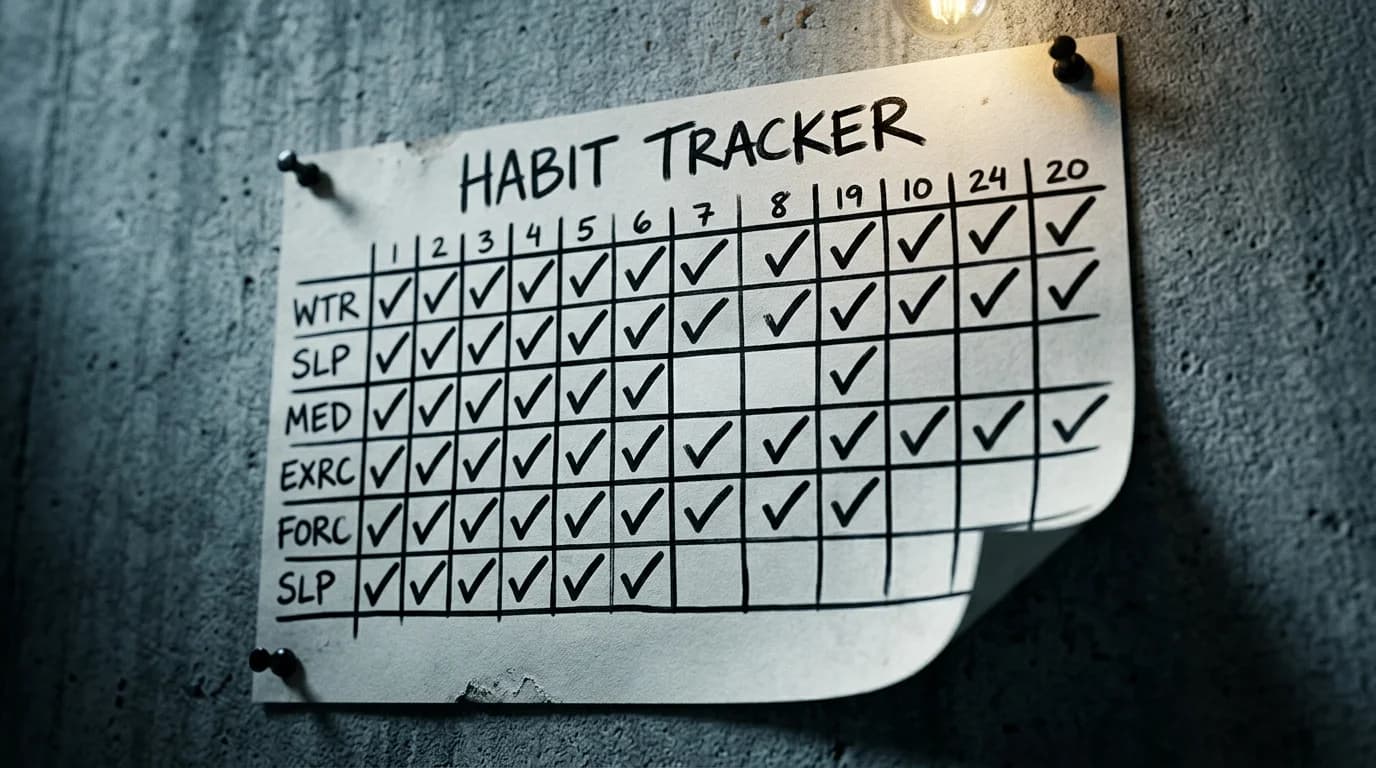
Compliance is the least glamorous number on the dashboard and the one that actually decides the month. It's a simple thing: the share of daily targets you've hit out of the targets available so far.
What makes it useful isn't the arithmetic. It's that it's the only metric in the program that can't be moved by water weight, and the only one you have complete control over today.
Why it exists
Weight is an outcome. Outcomes lag, they bounce, and they're partly out of your hands on any given day. Behaviour is an input, it's immediate, and it's entirely yours.
Track only the outcome and a flat week reads as failure even when you did everything right. Track the input alongside it and a flat week reads as what it usually is: a fluid artefact sitting on top of a perfectly good process.
The number that matters
You do not need 100%. What produces a result at day 30 is a high average held for four weeks — somewhere in the eighties and up — which is a very different psychological target from perfection.
The gap between those two framings is where most programs die. Perfection has a single failure state and no recovery path: the first missed target ends it. A percentage absorbs a bad day and keeps counting.
- Six targets a day, 180 across the program
- Missing four targets in a week still leaves you in the high eighties
- A missed day costs six. It doesn't cost the month
- The score never resets — it's an average, not a streak
Perfectionism is the actual risk
The failure pattern is well known and has a name in the behaviour-change literature: one lapse gets interpreted as proof the whole attempt has failed, and the lapse becomes a collapse. A missed session becomes a missed week.
The compliance score is designed as a direct counter to that. Look at it after a bad day and it will tell you, with numbers, that almost nothing happened. That's not consolation — it's accurate.
Using it properly
- Check it weekly, not hourly. It's a trend, like the weight line
- If it drops below the low eighties for a week, look for a pattern — it's almost always one target, not all six
- Don't chase a perfect day at 10pm with a pointless walk. Take the six-out-of-six tomorrow instead
- Pair it with the weight trend. High compliance plus a flat scale means wait, not cut
“The score you can hold for 30 days beats the score you can hold for four.”
Sources
Written by Coach D — the voice of the certified personal trainers behind the SHRED30 system. Educational content, not medical or dietary advice.
Day 1 is free.
Go deeper: the free anatomy nutrition and strength & conditioning study guides teach the science under every article.