All-or-nothing thinking is why the last plan failed

Think about how the last attempt actually ended. Almost nobody quits a program because the training was too hard or the food was wrong. They quit on a Wednesday, three days after a meal that didn't fit, having already decided the attempt was over.
That pattern is well described in the behaviour-change literature and it has a name: the abstinence-violation effect. It's worth understanding precisely, because it's the single most expensive failure mode in a 30-day cut and the arithmetic that beats it is trivial.
The effect, in plain terms
Set an absolute rule — no chocolate, never miss a session, perfect every day — and you've created a category with exactly two states: keeping it and having broken it. There is no partial state, because you defined it that way.
So the first lapse doesn't register as a small deviation. It registers as a change of category. You're no longer someone doing the program; you're someone who broke it. And once that's the story, the rest of the day, the weekend and eventually the month get spent in the new category, because there's nothing left to protect.
The tell is the sentence in your head. It's rarely I ate 600 extra calories. It's usually well, that's this week ruined — which is a claim about identity, not about food.
It shows up in training too, in a slightly different costume. A session missed on Tuesday becomes a reason to skip Thursday, because the week is already compromised and a partial week doesn't count. It counts. Three sessions is three sessions, and the plan does not award bonus points for symmetry.
What the meal actually cost
Run the numbers instead of the story. A large unplanned meal is a few hundred calories above your target, occasionally over a thousand. That is a fraction of one day's deficit, and your target is a daily average rather than a rule about any single meal.
Now run the numbers on the spiral. Writing off the rest of the day, then the weekend, then restarting on Monday costs you four days of deficit, four sessions, and a compliance figure that never recovers. The lapse cost you hours. The response costs you a week.
- The program is scored as a percentage, not a streak — one bad meal moves it barely at all
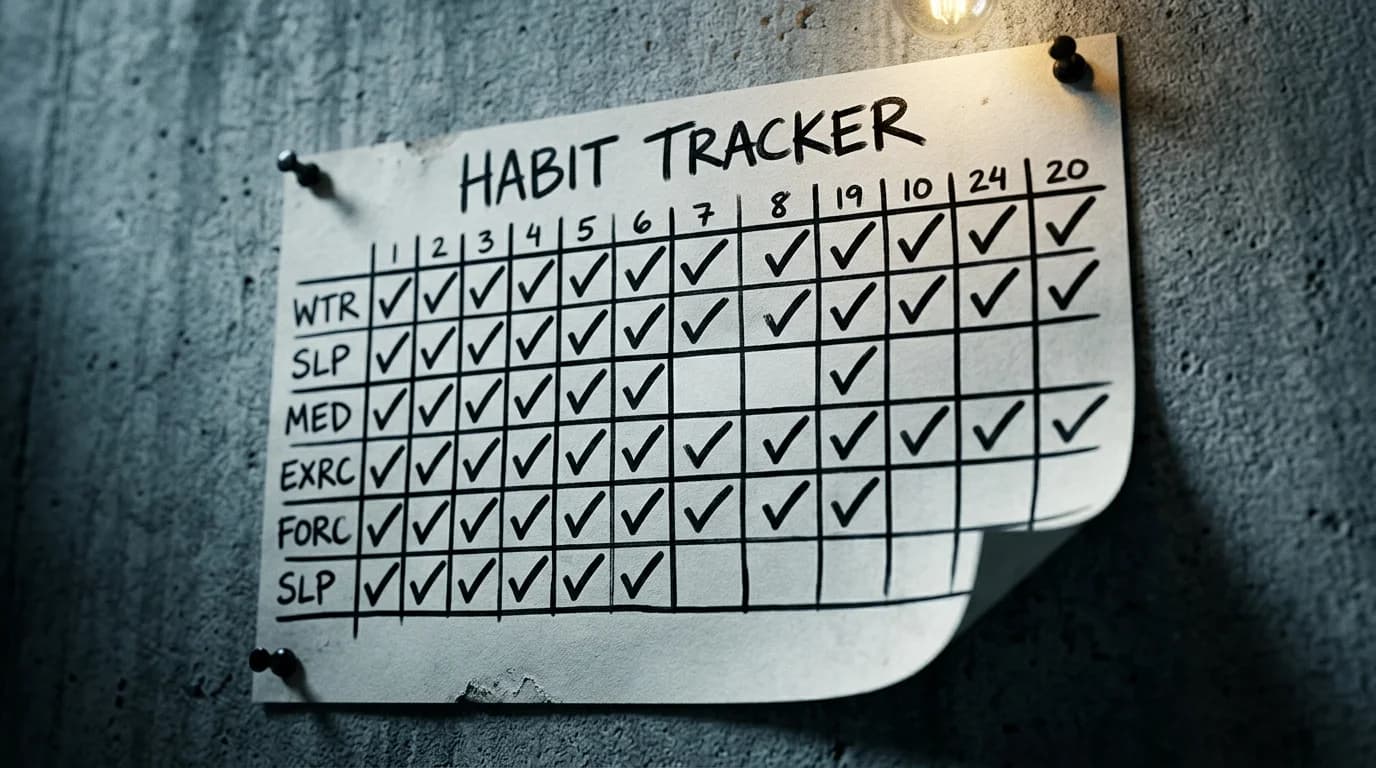
- Six targets a day, 180 across the month. A completely lost day costs six of them
- The deficit is a weekly average. A single high day gets absorbed by the six around it
- There is nothing to restart. Restarting on Monday is a choice to lose four more days first
- High compliance across thirty days is what produces the day-30 photograph. Nobody has ever hit 180 out of 180
The two-sentence rule
When something goes off plan, you get two sentences and then you move. The first states what happened, in plain quantities, with no adjectives. The second states the next scheduled action.
It looks like this: I ate a takeaway and about 900 calories over target, which is a bit more than half of one day's deficit. My next meal is breakfast, which is already in the plan. That's the entire intervention. No penance, no compensatory fasting, no punishment session, and specifically no extra cardio to work it off — which just teaches you that food is a debt that has to be paid in effort.
The reason it's two sentences is that the spiral lives in sentence three onwards. That's where the meal becomes evidence about your character. Cut the paragraph off before it gets there.
The next scheduled action is doing most of the work in that second sentence, and it should be genuinely the next one — not a corrective one. If dinner went sideways, the next action is bed at a sensible hour. If lunch went sideways, the next action is the walk you had planned anyway. Returning to the schedule is the entire recovery protocol; there isn't a second half.
“The meal costs you a few hundred calories. The story about the meal costs you the month.”
Building a plan that can't be broken
The rule is a patch. The structural fix is to stop writing rules that have a broken state. The Daily Six are counted, not sworn — you hit five out of six and the dashboard records five out of six. The compliance score never resets. What to do when you miss a day is a page in the playbook rather than an emergency.
If perfectionism around food is a long-standing pattern for you, or if a single meal reliably produces days of guilt or restriction, that's worth raising with a clinician rather than managing with a better checklist. A program should be a tool you use, not a thing that gets to grade you.
Sources
Written by Coach D — the voice of the certified personal trainers behind the SHRED30 system. Educational content, not medical or dietary advice.
Day 1 is free.
Go deeper: the free anatomy nutrition and strength & conditioning study guides teach the science under every article.