Why fats are measured and vegetables never are
Every food named in this article is an example, not an instruction — one way a person might choose to meet their targets. Swap anything for foods that fit your own needs, allergies, budget and beliefs. For advice specific to you, talk to a registered dietitian or your physician.
Two rules in the playbook look inconsistent. Fats are given exact portions — a thumb of oil, a small handful of nuts, half an avocado. Green vegetables have no portion at all; if you're hungry, eat more of them.
It isn't inconsistent. It's the same rule applied to two foods that sit at opposite ends of one measurement: calories per gram.
The arithmetic
Fat carries nine calories per gram. Protein and carbohydrate carry four. That means fat is not slightly more calorie-dense than everything else on your plate — it's more than twice as dense, before you account for the fact that fatty foods also tend to contain very little water.
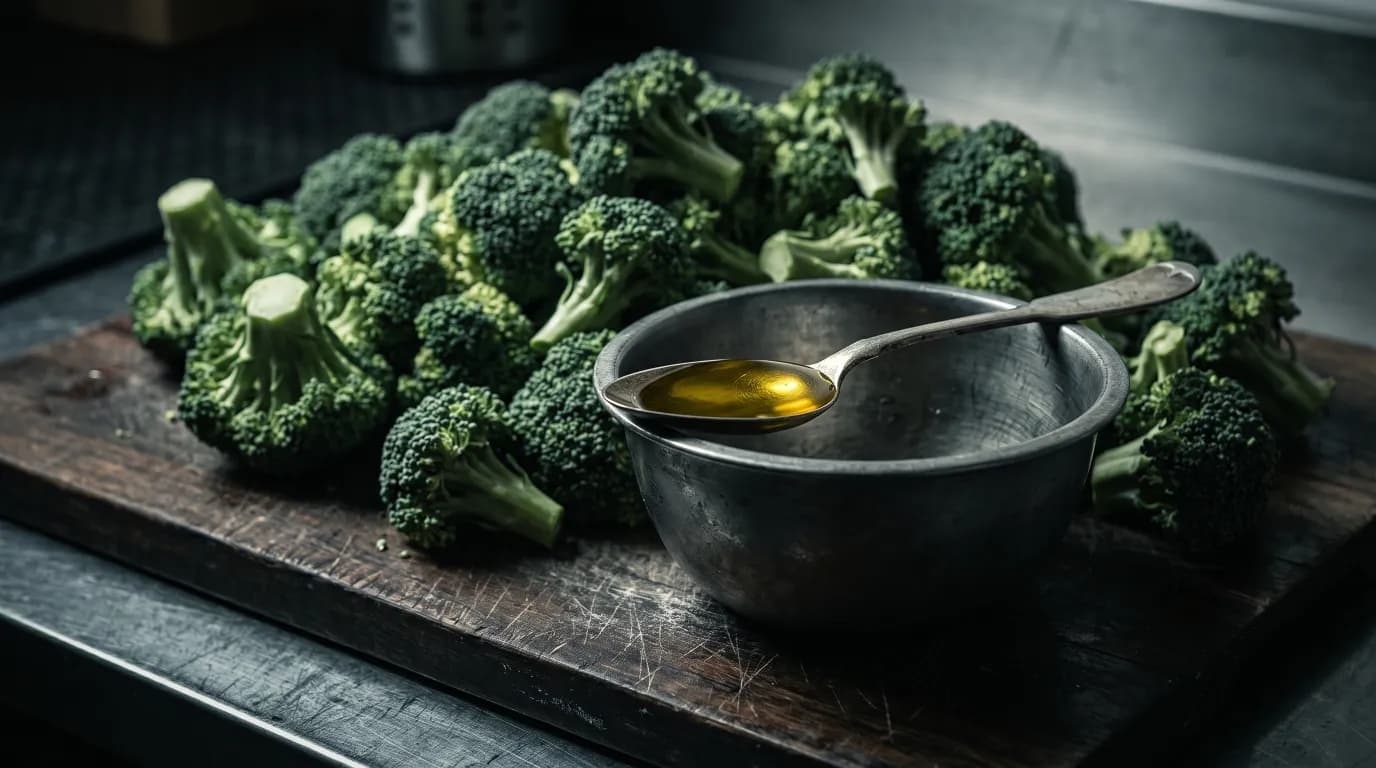
Run it through real food. A level tablespoon of olive oil is about 14 grams and roughly 120 calories. Raw broccoli is about 34 calories per 100 grams. So that one spoonful of oil costs you the same calories as somewhere around 350 grams of broccoli — a full mixing bowl of it, which almost nobody eats in a sitting.
Hold that comparison in your head for a moment, because it is the whole article. One spoon, ten seconds, no impression on your appetite whatsoever, against a quantity of vegetable you would struggle to finish and would still be chewing twenty minutes later. Identical numbers on the dashboard. Nothing else about them is remotely alike.
Why fat is easy to lose track of
Density is only half of it. The other half is that fat adds calories without adding much of anything you'd notice — no volume, no chewing, no weight in the stomach. A pan filmed with oil, a dressing poured rather than spooned, a nut butter jar attacked with a tablespoon: each of those is easily 100 to 200 calories that leave no impression at all.
That's why the fats column has numbers next to it. Not because fat is bad — it isn't, and cutting it to zero is a genuinely poor idea — but because it is the only macronutrient you can add several hundred calories of without your meal looking any different.
- Cooking oil poured freehand: usually two to three times what the recipe assumed.
- Salad dressing: often more calories than the salad it's on.
- Nuts and nut butter: excellent food, roughly 6 calories per gram, and famously hard to stop eating.
- Cheese and full-fat dairy: fine in a measured portion, quietly enormous when grated by eye.
- Avocado: a whole medium one is more like a fat portion and a half.
Why vegetables get set free
Non-starchy vegetables run somewhere in the region of 20 to 35 calories per 100 grams — mostly water and fibre, wrapped around a small amount of carbohydrate. They take up room in your stomach, they take time to chew, and they deliver micronutrients the rest of the plate doesn't.
The practical consequence is that overeating them by accident is close to impossible. To eat 300 calories of green beans you'd need well over a kilogram of green beans. So the program spends no attention on measuring them, and instead points you at them whenever you're hungry — which is exactly what the playbook means by protein and green vegetables being effectively unlimited.
“Anything that pours, spreads or comes out of a jar gets measured. Anything green and leafy gets ignored.”
Where to spend the fat you do measure
Depending on your target you have somewhere in the region of two to four fat portions a day. They're worth spending deliberately, because unlike the vegetables, you only get so many.
Spend them on things that buy something: olive oil over vegetables you'd otherwise not finish, oily fish that carries omega-3s with it, a weighed handful of nuts eaten as an actual snack. Don't spend them on cooking. Oil in a hot pan is a lubricant rather than a flavour, and a non-stick pan, a spray, or a splash of water does the same job for a fraction of the cost. That one change frees close to a whole portion a day for most people, and nothing on the plate tastes different.
Dressings deserve the same treatment. Mix your own from a measured spoon of oil, vinegar, mustard and lemon, and you know exactly what went on the salad. Pour it from a bottle and the honest answer is that you don't, and the number is almost always higher than you'd guess.
What not to conclude
Don't read this as a case for a low-fat diet. Fat carries the fat-soluble vitamins A, D, E and K, supplies fatty acids your body can't make, and makes food taste like food — and dietary guidance consistently places it as a substantial share of total calories, not a trace. Stripping it out produces a miserable plan you'll abandon in week two.
Read it as a case for knowing where it goes. Measure the oil, the nuts and the avocado, then stop thinking about it. The vegetables will look after themselves.
Sources
Written by Coach D — the voice of the certified personal trainers behind the SHRED30 system. Educational content, not medical or dietary advice.
Day 1 is free.
Go deeper: the free anatomy nutrition and strength & conditioning study guides teach the science under every article.