1g per pound of goal weight: where your protein number comes from
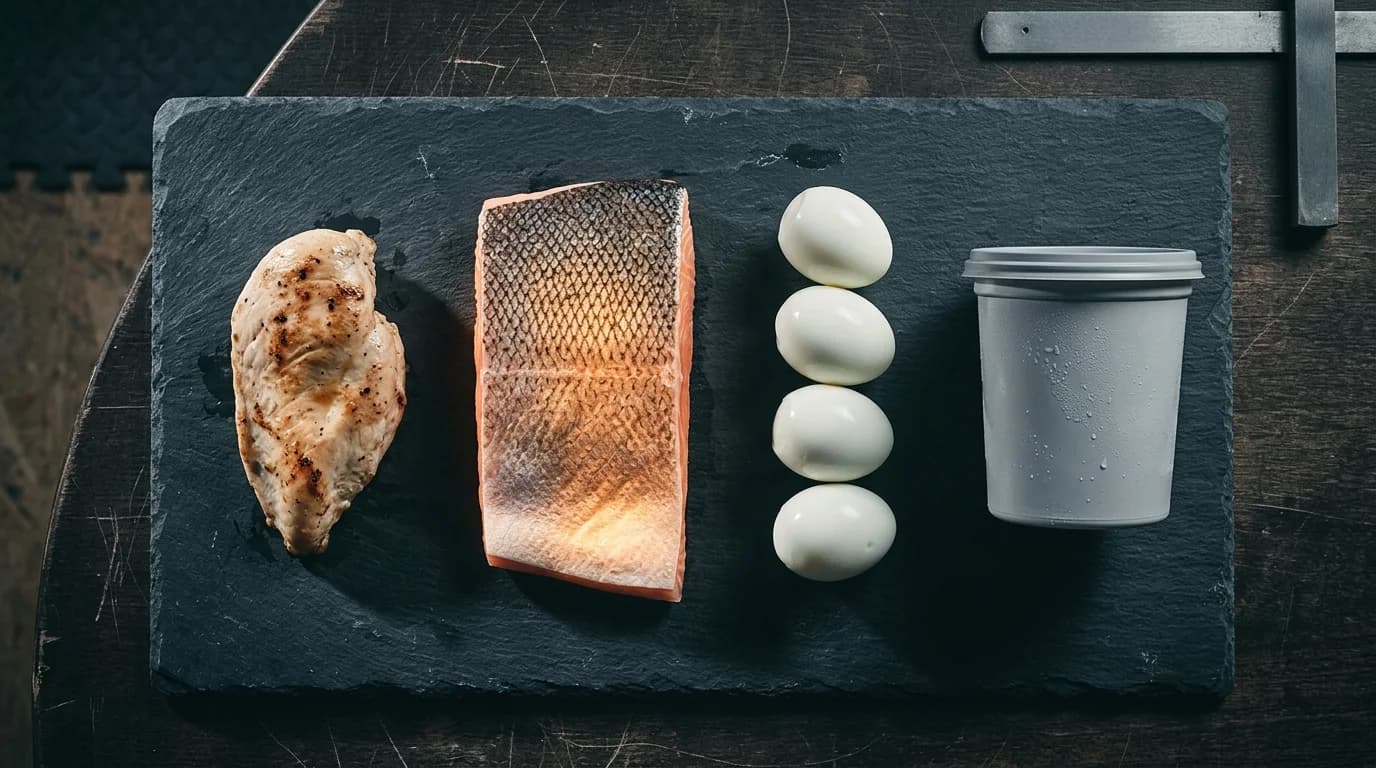
Every food named in this article is an example, not an instruction — one way a person might choose to meet their targets. Swap anything for foods that fit your own needs, allergies, budget and beliefs. For advice specific to you, talk to a registered dietitian or your physician.
One gram per pound of goal weight is the most quoted number in fat loss and one of the least explained. It sounds like something invented in a gym car park. It isn't — it lands almost exactly where the peer-reviewed guidance does, once you convert the units.
Here's the derivation, and the two situations where the number should be different.
The published range
The International Society of Sports Nutrition's position stand on protein places the intake for building and maintaining muscle mass at roughly 1.4 to 2.0 grams per kilogram of body weight per day, and notes that higher intakes may be warranted for people training hard, particularly while restricting calories.
Convert the top of that range and you get about 0.9 grams per pound. Which is to say: the program's rule of thumb is the upper half of the published range, expressed in a unit you can do in your head.
Why goal weight, not current weight
Anchoring to current weight has a perverse effect: the further you have to go, the more protein you're told to eat, and the target shrinks as a reward for progress. Neither is useful.
Goal weight fixes both. The number is set once, it doesn't move all month, and it scales to the body you're building rather than the one you're leaving. For someone with a lot to lose, it's also the difference between a target they can hit and a target that reads like a dare.
- One fixed number for all 30 days — no recalculating
- Sits in the upper half of the ISSN range for most people
- Doesn't balloon for people with more to lose
- Doesn't quietly fall as you get closer to the goal
What it buys you
Two things, both of which decide whether the month produces a photo you like. The first is lean tissue: in a deficit, high protein plus resistance training is the combination that biases the loss toward fat.
The second is that it makes the calorie target survivable. Protein is the most satiating macronutrient per calorie, which is why the same 1,500 calories built around protein feels like a plan and built around toast feels like a punishment.
Where the number should be different
Two cases. If you're eating entirely plant-based, aim slightly higher and spread it more evenly, because plant proteins are generally lower in leucine and less completely digested — the fix is more total protein and more eating occasions, not a supplement.
And if you have kidney disease or any condition where protein intake is medically managed, this number is not for you. That's a conversation with your clinician, not with an app.
“It isn't a bodybuilding number. It's the top half of the published range, written in pounds.”
Hitting it without a spreadsheet
- Divide by four. A quarter of the target at each of four eating occasions is the whole strategy
- One swap-table protein portion — a palm and a half — is roughly 40–50 grams for most sources
- Breakfast is where the gap opens. A carbohydrate-only breakfast usually accounts for the entire shortfall
- Track for three days at the start, then stop. You'll know your portions by day four
Sources
Written by Coach D — the voice of the certified personal trainers behind the SHRED30 system. Educational content, not medical or dietary advice.
Day 1 is free.
Go deeper: the free anatomy nutrition and strength & conditioning study guides teach the science under every article.