Vegetables are the off-switch: the volume-eating principle
Every food named in this article is an example, not an instruction — one way a person might choose to meet their targets. Swap anything for foods that fit your own needs, allergies, budget and beliefs. For advice specific to you, talk to a registered dietitian or your physician.
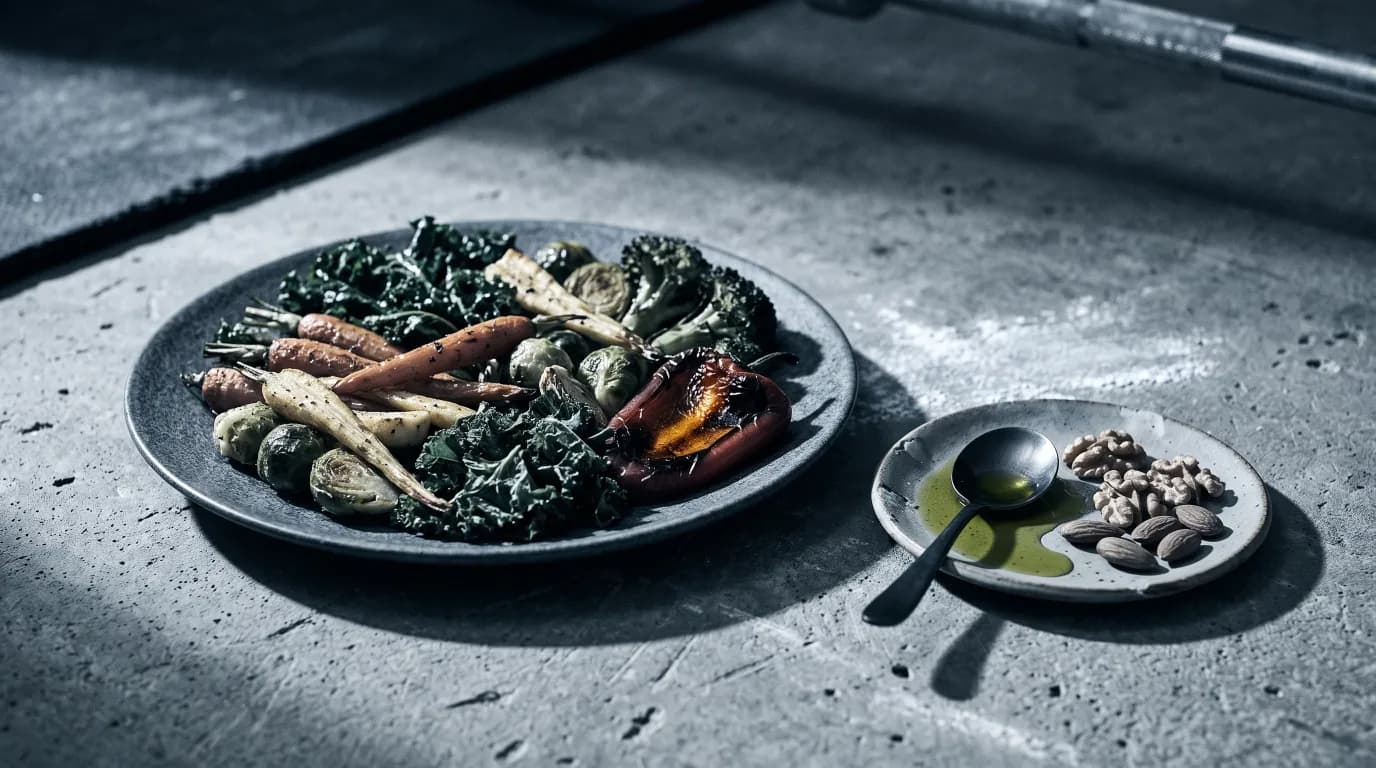
The playbook has one line that sounds like filler and isn't: if you're hungry, the answer is protein and green vegetables — both effectively unlimited. That sentence is doing more work than any other rule in the program.
It rests on a finding about how appetite works that most fat-loss advice ignores completely: people tend to eat a fairly consistent weight of food from day to day, rather than a consistent number of calories.
Energy density, in one number
Energy density is calories divided by grams. Non-starchy vegetables land around 0.2 to 0.4 calories per gram. A boiled potato is near 0.9. Cooked rice about 1.3. Chicken breast about 1.65. Bread around 2.6. Nuts about 6. Oil is 8.8, the theoretical ceiling.
Water is the single biggest lever on that number, because it adds weight without adding calories. Fibre is the second. Fat pushes it the other way, hard. Which means you can change the calorie content of a meal by a factor of three or four while the plate in front of you looks roughly the same size.
Notice where protein sits on that scale. Lean protein is only moderately dense — chicken breast is closer to broccoli than it is to bread — which is why the playbook puts protein and vegetables in the same unlimited category. They're the two things on the plate you can eat a lot of without the calorie number running away from you.
Why the weight of food matters
Fullness is signalled partly by stretch — the physical volume in your stomach — and by how long food takes to leave it. Neither of those signals reads calories. A bowl holding 300 grams of food registers as a bowl holding 300 grams of food, whether that's 200 calories or 900.
Research on energy density has run this experiment many times over: hold the food weight constant, lower the energy density, and people eat fewer calories at the same reported fullness. They do not compensate later, at least not fully. That is the whole principle, and it's why the program sets vegetables free instead of rationing them.
Five templates that use it
Each of these keeps the calorie number where your dashboard wants it and roughly doubles what's on the plate.
- Double the vegetables in any stir-fry and halve the oil, measuring the oil with a spoon rather than pouring it. Same dish, several hundred calories lighter, visibly larger.
- Build lunch as a base of leaves and raw vegetables with a full protein portion on top, and keep the dressing to one measured tablespoon.
- Bulk mince dishes with finely chopped mushrooms, courgette or onion at roughly one part vegetable to one part meat. Bolognese, chilli, curry — the texture survives, the calories per bowl fall sharply.
- Start dinner with a bowl of clear vegetable soup or a plain side salad. It costs almost nothing and reliably takes the edge off the main course.
- Swap half the rice for cauliflower rice rather than all of it. All of it feels like a punishment; half of it just feels like a bigger portion.
The two limits
This is not permission to build a day out of lettuce. Protein still comes first at every meal — volume without protein produces a full stomach, a missed target, and a hungrier tomorrow. Vegetables are what you add after the protein is on the plate, not instead of it.
And there's a floor. Push energy density low enough across an entire day and you can end up genuinely under-fuelled: flat sessions, poor recovery, and a training block that stops progressing. If you're routinely eating enormous volumes and still hungry, that's usually a signal your calorie target is too low for you rather than a sign to add more broccoli — and if it comes with dizziness or your training collapsing, check in with a clinician rather than pushing on.
“Your stomach measures grams and your dashboard measures calories. Volume eating is the gap between the two.”
The foods that break the rule
Two categories undo the principle so completely that they're worth naming. The first is anything you drink. Blend fruit into a smoothie and you keep every calorie, lose the chewing, and empty your stomach far faster than the whole fruit would have. It's the same food with the volume advantage engineered out of it — which is a large part of why the program bans liquid calories outright for the thirty days.
The second is dried fruit, where the water has been removed on purpose. Grapes run around 0.7 calories per gram; raisins are closer to 3. Identical fruit, four times the density, and a handful goes down in seconds. The same logic applies to crisps, crackers and anything else designed to be dry, crisp and easy — those are not accidents of processing. They're the volume principle run in reverse by people who were very good at it.
Sources
Written by Coach D — the voice of the certified personal trainers behind the SHRED30 system. Educational content, not medical or dietary advice.
Day 1 is free.
Go deeper: the free anatomy nutrition and strength & conditioning study guides teach the science under every article.