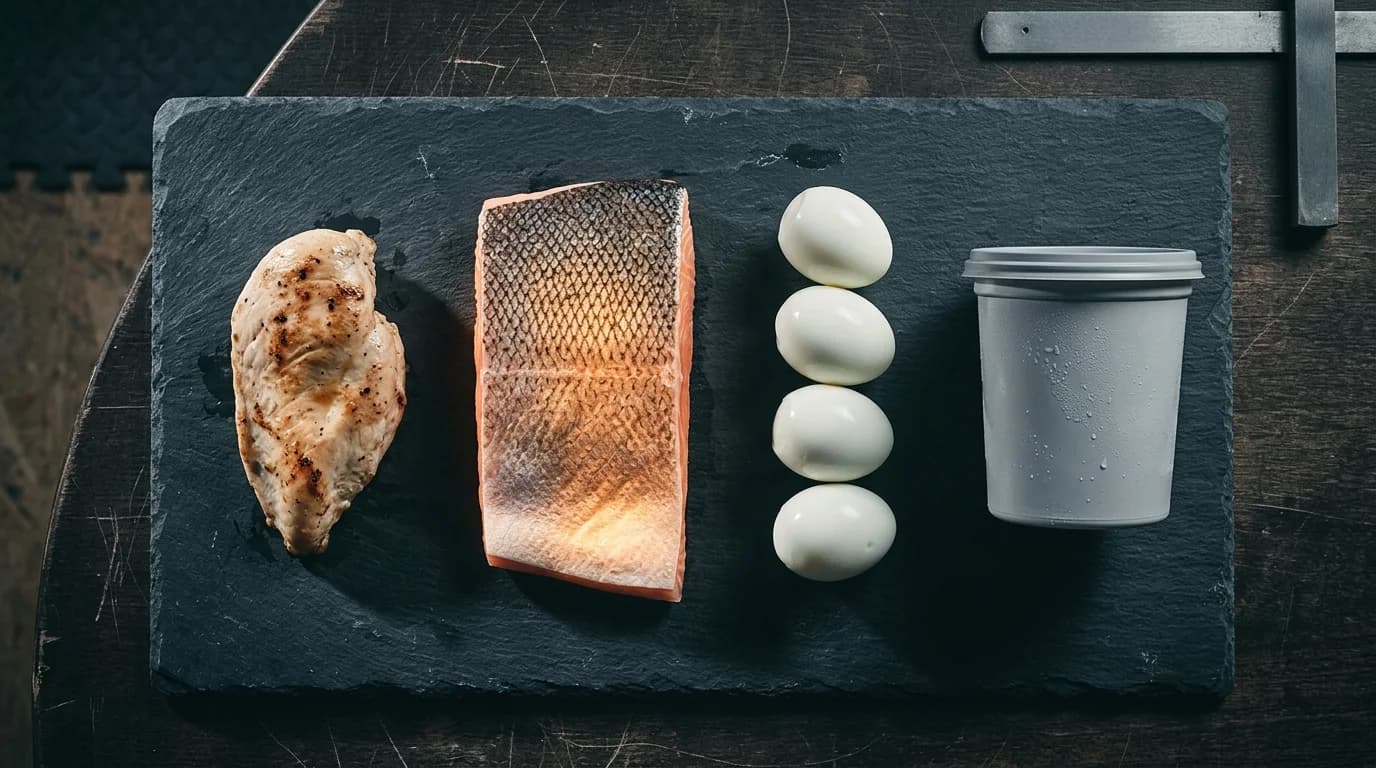
Protein sources ranked by grams per 100 calories
Every food named in this article is an example, not an instruction — one way a person might choose to meet their targets. Swap anything for foods that fit your own needs, allergies, budget and beliefs. For advice specific to you, talk to a registered dietitian or your physician.
A chicken breast and a chicken thigh sound like the same food. One buys you roughly 19 grams of protein for every 100 calories it costs; the other lands nearer 13. Repeat that choice four times a day for a month and it decides whether your protein target is comfortable or a fight every evening.
Labels rank protein per serving, which flatters anything fatty. On a cut, the calories are the constraint, so the useful ranking is protein divided by the calories it arrives in. Here is the swap-table list sorted that way.
Why per 100 calories is the honest unit
Take a cod fillet and a salmon fillet of the same weight. USDA data puts their protein within a few grams of each other. The salmon carries around double the calories, because fat rides along at nine calories a gram against four for protein.
That difference is not a verdict on the food. It is a statement about what the food costs you. Dividing grams by calories tells you how much of your daily budget is left for everything else once the protein is handled — and on a 1,600-calorie day, that headroom is the entire difference between a plan you can live in and one you can't.
There's a second reason to use this unit. Protein per serving depends on a serving size a manufacturer chose, and serving sizes are marketing. Protein per 100 calories can't be gamed. It's a property of the food, and it stays true whether you eat 80 grams of it or 300.
The league table
Rounded, cooked, and drawn from USDA reference values. Treat the bands as the point rather than the decimal places — brands, cuts and cooking method all move the numbers a little.
Two things fall out of the list immediately. Fish and shellfish dominate the top, because they are lean by default rather than by trimming. And the plant sources cluster at the bottom — not because they're poor protein, but because carbohydrate or fat is attached to them and can't be cut off the way it can be cut off a chicken thigh.
- Roughly 20–24g per 100 calories: prawns, white fish like cod or haddock, egg whites, tuna in water, whey isolate. As close to pure protein as food gets.
- Roughly 17–19g: skinless chicken breast, turkey breast, non-fat Greek yogurt, low-fat cottage cheese. This band is the everyday core of the meal plan for a reason.
- Roughly 13–16g: 93–95% lean beef, pork tenderloin, standard whey concentrate. Still strong, with slightly more fat along for the ride.
- Roughly 9–12g: whole eggs, salmon, firm tofu, tempeh, 80% lean mince. Genuinely good food that simply costs more calories per gram of protein.
- Under 9g: lentils, beans, chickpeas, nuts, hard cheese. Worth eating for other reasons. Not the thing that gets you to your number.
What the top band is actually buying
Say you need 40 grams of protein at dinner. From cod, that's around 180 calories on the plate. From a farmed salmon fillet, closer to 360. Same protein, and the difference between them is roughly a bowl of oats, or a generous pour of olive oil over your vegetables.
This is why the swap table exists at all. Swapping inside a category at the stated portion keeps the protein constant and moves the calories, so you can pick the version that leaves room for the rest of the day. Two or three top-band choices a week is usually all it takes to stop the evening scramble.
The same arithmetic runs at breakfast, where the gap usually opens. Three whole eggs give you roughly 19 grams of protein for about 220 calories. Two whole eggs plus a carton-worth of egg whites gives you nearer 24 grams for about 200. Neither of those is a hardship. One of them just leaves more of the morning intact.
Where the ranking stops mattering
The list is a tool for the days when the number is hard, not a moral order. Salmon carries omega-3 fats you have good reason to eat. Whole eggs carry choline and fat-soluble vitamins the whites do not. Building every meal from the top band produces a boring plate by about day nine, and a boring plate is the most reliable way to end a program early.
Use the ranking where it helps: the meal that has to be cheap in calories, the day you're already close to your limit at 6pm, the lunch you eat five times a week. Everywhere else, eat the food you'll actually keep eating.
“Rank food by the calories it costs you, not by the grams on the front of the packet.”
Putting it on the grocery list
- Buy one top-band protein per shop — a bag of frozen prawns or white fish covers the low-calorie dinners for a week.
- Keep two no-cook options in the fridge: non-fat Greek yogurt and low-fat cottage cheese cover breakfast and the late gap.
- Tuna pouches and a tub of whey belong in the emergency kit, not the daily plan. They are there for the days that go wrong.
- Check the label on anything pre-cooked, marinated or breadcrumbed. The coating routinely moves a top-band protein two bands down before it reaches your plate.
- If you have a kidney condition or your protein intake is medically managed, this ranking is not for you — set your target with your clinician instead.
Sources
Written by Coach D — the voice of the certified personal trainers behind the SHRED30 system. Educational content, not medical or dietary advice.
Day 1 is free.
Go deeper: the free anatomy nutrition and strength & conditioning study guides teach the science under every article.