Interval training without thinking: using the workout timer
Interval work fails for a boring reason. It isn't that people can't work hard — it's that halfway through the third round they're the ones deciding when the rest ends, and a person forty seconds into oxygen debt is the worst available judge of that.
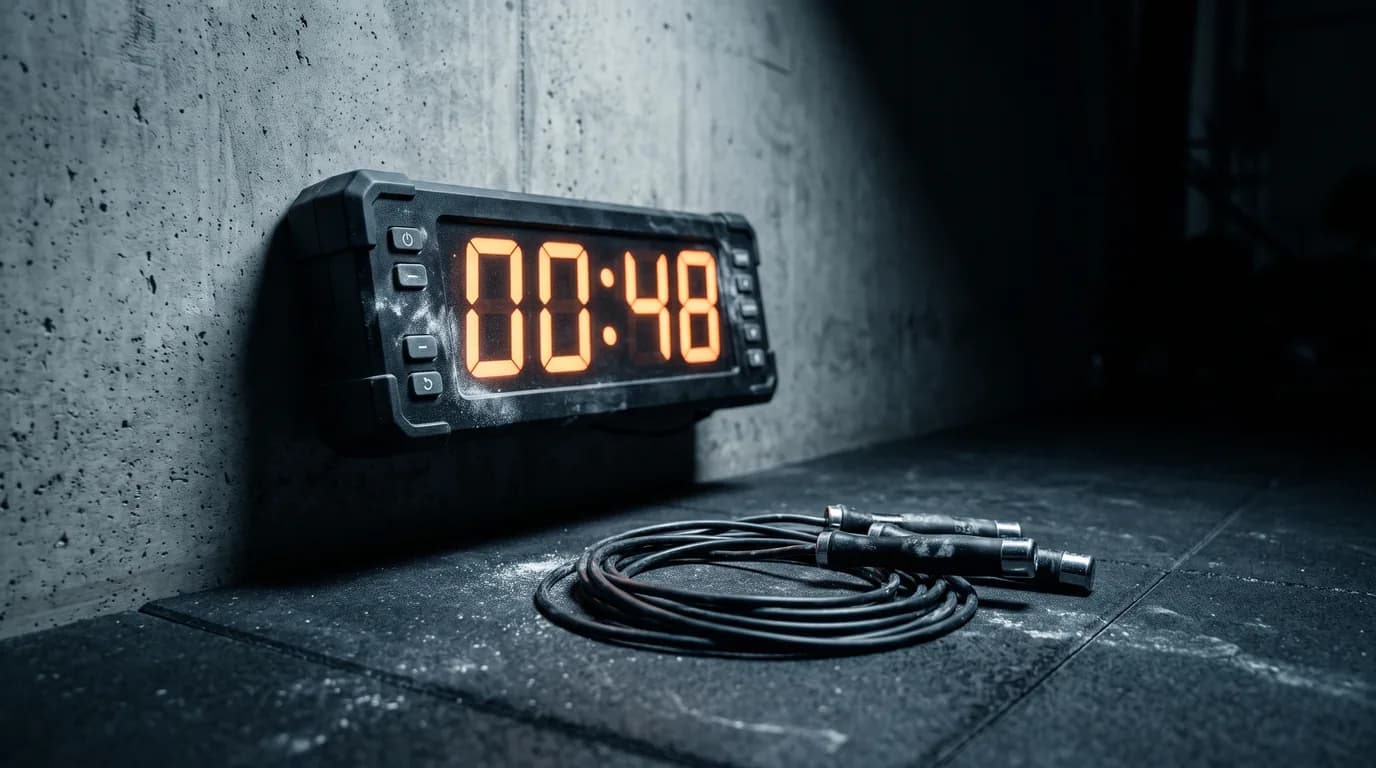
The workout timer removes the decision. Thirty seconds of work against forty-five of recovery, running whether you agree with it or not.
Why the ratio is built that way
Longer rest than work looks generous. It's the opposite: it's what makes genuinely high intensity possible. If the rest is too short, effort collapses to a moderate slog by round three and you end up doing medium-hard cardio while believing you did intervals.
The point of a hard interval is that each one is close to your ceiling. That requires enough recovery to go again at something near full output, which is why the work block is short and the recovery isn't. Guideline bodies are consistent that vigorous work counts roughly double toward weekly activity totals — but only if it's actually vigorous.
Thirty seconds is chosen for the same reason. It's long enough that the last ten seconds genuinely hurt and short enough that you can hold something close to full output for all of it. Stretch the work block to a minute and almost everyone slows down halfway through, which turns a hard interval into a moderate one with a stressful ending.
The last decision, removed
Every judgement call you make mid-session is one you'll eventually make in your own favour. Rest creeps from forty-five seconds to seventy without you noticing. Rounds get quietly dropped when the count is in your head. The interval that felt like it lasted forever was twenty-two seconds.
A timer running on the screen fixes all three at once. You start when it says start, you stop when it says stop, and the only thing left for you to supply is effort. That's the whole design: reduce a hard session down to one input, then spend everything on that input.
- Set it up and start it before the first round — not between rounds, when you're breathing hard
- Put the phone or screen where you can see it without holding it
- Keep moving through the recovery block. Standing still drops you further than a slow walk does
- If you miss the start of a round, join it late rather than restarting the whole set
- Count rounds on the timer, never in your head — the number in your head is always lower
Two cues that tell you it was a nine
The first is speech. At a genuine nine out of ten you can produce a word or two, not a sentence. If you can answer a question in a full clause at the end of a work block, you were somewhere around a seven. This is the talk test, and it tracks the point where breathing changes gear reasonably well without any equipment at all.
The second is decay. Watch your output in the last ten seconds of a work block against the first ten. At a true high effort it visibly drops — the pace slows, the reps get slower, and holding the same rate to the buzzer isn't possible. If your final round looks identical to your first, you paced the session rather than pushing it.
“If you could have held that pace for another minute, it was not a nine.”
What to do inside the work block
Pick one movement and commit to it for the whole set. Swapping exercises mid-session means the first round of each is spent working out the rhythm, and thirty seconds isn't long enough to lose ten of them to setup. Bike, rower, hill, skipping rope, kettlebell swings — any of them work, and the best one is the one you can start within two seconds of the buzzer.
Go out hard on the first round rather than building into it. People instinctively pace round one as a warm-up, then discover they had more in them on round five, by which point the session is over. The warm-up happens before the timer starts. Once it's running, round one should already be close to the ceiling.
Who should scale this back
High-intensity work is demanding on a system that's already in a deficit, and it isn't the right starting point for everyone. If you're new to structured exercise, returning from an injury, pregnant, or managing a heart, lung or blood-pressure condition, talk to a clinician before you run vigorous intervals — and use the plan's lower-intensity options in the meantime, which do most of the same work more slowly.
For everyone else, the scaling is straightforward: keep the timer exactly as it is and reduce what you do inside the work block. Fewer reps, a lower step, a slower pace. Two rounds finished properly beat five rounds abandoned in the middle, and the timer doesn't care which one you pick — it just stops you negotiating with it.
Sources
Written by Coach D — the voice of the certified personal trainers behind the SHRED30 system. Educational content, not medical or dietary advice.
Day 1 is free.
Go deeper: the free anatomy nutrition and strength & conditioning study guides teach the science under every article.