Screens 45 minutes before bed: what the evidence supports
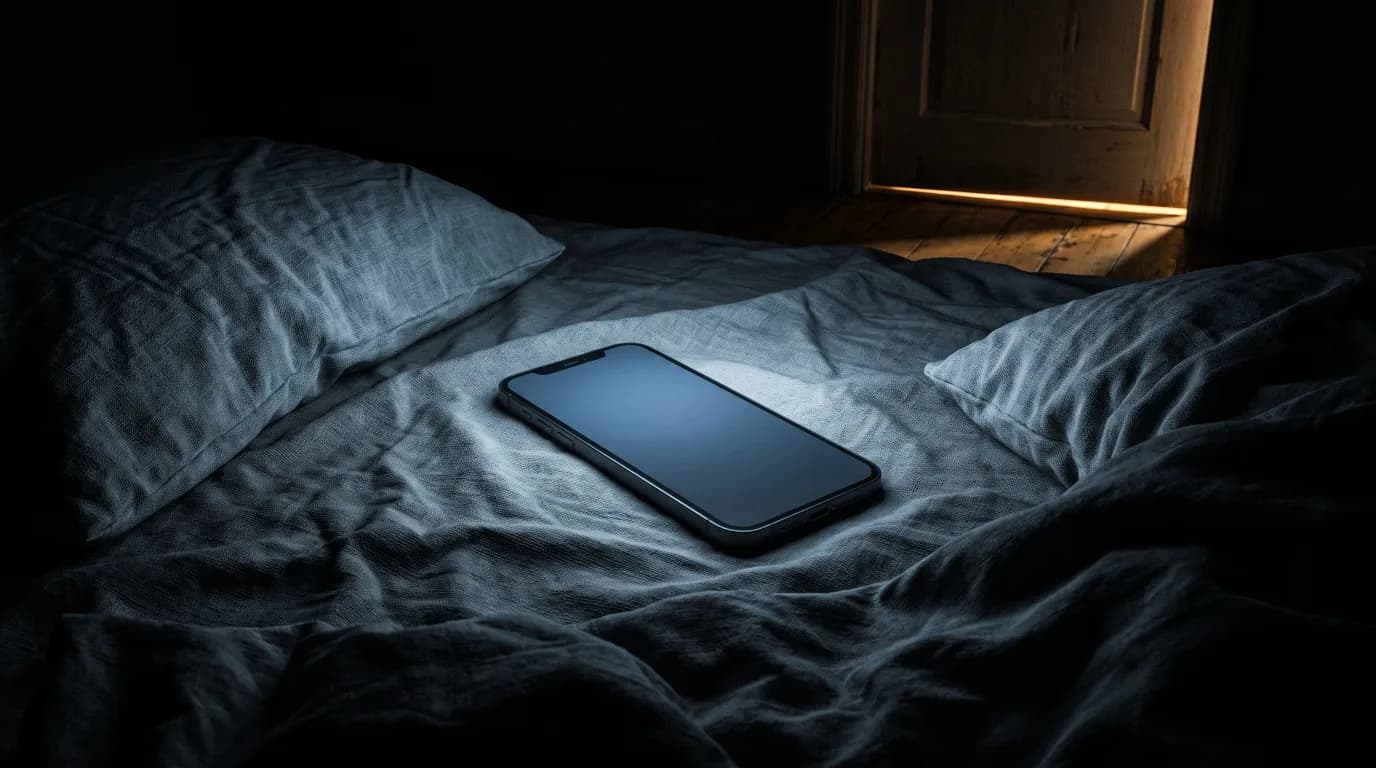
The standard advice is no screens for an hour before bed, usually justified with blue light. Most people try it for three nights, find it impossible, and quietly abandon the whole idea of a wind-down.
That's a shame, because the rule is roughly right and the reasoning behind it is mostly wrong. There are three separate mechanisms here, they are not equally important, and once you can tell them apart you get a version of the rule you can actually keep.
The light story
Light exposure in the evening does suppress melatonin and does shift your body clock later. That part is real and well established. The question is how much of it a phone at arm's length actually delivers.
The honest answer is: less than the headlines suggest. A screen held near your face is bright compared to a dark bedroom and dim compared to daylight or a well-lit kitchen. Studies that swap the light out — night-shift settings, amber glasses, dimmed displays — tend to find small effects on when people fall asleep, not the dramatic ones the accessory market implies.
So use night mode and turn the brightness down. It's free and it isn't nothing. Just don't expect it to be the fix, and don't buy anything.
The one place the light story is genuinely large is the room itself. Overhead lights in a kitchen or bathroom at 11pm deliver far more light to your eyes than a phone does, and nobody thinks to dim them. If you're going to spend effort on light, spend it on lamps rather than on a screen filter.
The stimulation story
This is the bigger one. Falling asleep requires arousal to fall, and the content on the screen is designed by people whose job is to prevent exactly that. Work email raises your heart rate. An argument in a comment thread raises it more. A short-video feed is engineered so that the natural stopping point never arrives.
Which means the medium is close to irrelevant and the content is nearly everything. Reading a novel on a tablet at low brightness is not the same activity as scrolling on a tablet at low brightness, even though the light is identical.
The same logic explains why the rule feels arbitrary when you apply it flatly. Banning the device bans the calm uses along with the activating ones, and the calm uses were never the problem.
The stolen hour
The third mechanism doesn't involve your brain chemistry at all. Screens displace sleep by consuming the time it was going to happen in. One more episode, one more scroll, and lights-out has moved forty minutes later than you intended.
For most people this is the largest single cost of the phone in bed, and it's invisible in the way that all time is. Nobody decides to lose an hour. They decide eleven separate times to spend three more minutes.
It's also the mechanism most responsive to a rule, which is convenient. You cannot decide to be less physiologically aroused by a news story. You can decide that the phone charges in the kitchen, and that decision holds without any willpower at the moment it matters.
“The screen doesn't keep you awake nearly as effectively as it keeps you from going to bed.”
The version people keep
Forty-five minutes, not an hour, and the target is the activating content rather than the device. A shorter window you hold every night beats a longer one you abandon in week one — the same logic as the compliance score, applied to the last hour of the day.
- Set the boundary at 45 minutes before lights-out and put a recurring alarm on it for the first week
- Cut the stimulating categories first: work email, news, social feeds, anything with an infinite scroll. Those are the ones raising arousal
- Keep the calm ones if they help — a book, a podcast, low-brightness night mode on something you'll actually finish
- Charge the phone in another room. If it's on the nightstand, the rule has already failed
- Pair the window with something physical — shower, teeth, room cold, lights low — so the wind-down has a shape rather than being an absence
What it's worth
Realistically, somewhere between fifteen and forty minutes of extra sleep for most people, most of it coming from the displacement mechanism rather than the light one. That is enough to move a six-and-a-half-hour night onto the right side of the seven-hour threshold that the sleep guidelines set for adults, which is the entire point during a month like this one.
There's a second return that doesn't show up as minutes. The forty-five-minute window is where the room protocol gets executed — lights down, temperature down, phone out — so keeping it is what makes the rest of the sleep target run on rails instead of on memory.
If you're doing all of this and still lying awake for an hour, the problem isn't the screen and another rule won't fix it. Persistent insomnia is worth taking to a clinician, who has better tools than a wind-down routine.
Sources
Written by Coach D — the voice of the certified personal trainers behind the SHRED30 system. Educational content, not medical or dietary advice.
Day 1 is free.
Go deeper: the free anatomy nutrition and strength & conditioning study guides teach the science under every article.