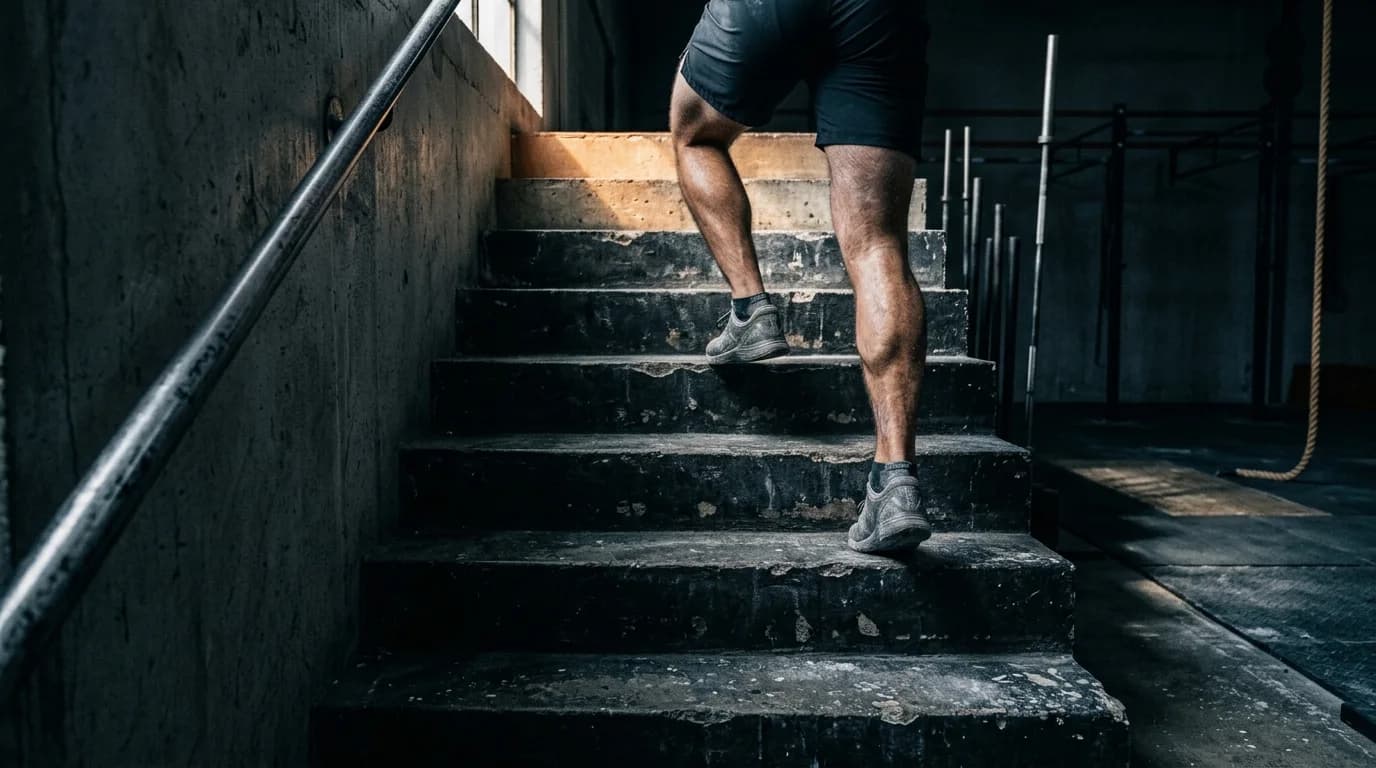
Lower Body Power: the highest-value session in the program
One session each week costs more than the rest, and it is the one people are most tempted to move. Lower Body Power sits on days 1, 8, 15, 22 and 29 — the opening working day of every week in the plan — and the placement is not an accident of scheduling.
It is there because the quads, glutes and hamstrings are the largest block of trainable tissue you own, and a session that loads all of them at once is the closest thing in the program to a whole-body demand. Everything about how the day is built follows from that.
Three patterns, not eight exercises
The session looks long on the plan page and it is actually very simple. There are three movement patterns in it, and every other line on the day is an accessory to one of them.
Learn to see the session as patterns rather than exercise names and substitution becomes easy. If the rack is taken, you are not looking for a back squat — you are looking for anything that loads a deep knee bend under a weight you can control.
Depth is part of the prescription rather than a detail. A half squat at a heavy load trains a shorter range than a full one at a lighter load, and the deeper version is the harder session even when the number on the bar is smaller. Pick the weight that lets you reach the bottom position you actually own, then earn the rest of the range over the month.
- A squat pattern — back squat, goblet squat or leg press — loads the quads through a deep knee bend and asks your trunk to stay rigid while it happens
- A hinge — Romanian deadlift, hip thrust or good morning — loads the hamstrings and glutes at the hip while the knees stay nearly still
- A single-leg pattern — split squat, lunge or step-up — exposes the side-to-side difference a barbell hides, at a load your spine barely notices
- A finisher — calves, or a loaded carry — covers what the big three under-serve
Why it costs the most
The energy cost of a set scales with how much muscle you are asking to contract and how far you are moving a load. A set of ten squats moves most of your body mass through a long range; a set of ten lateral raises moves a few pounds through a short one. Those are not the same afternoon.
That is also why the day after shows up on the scale in a way that has nothing to do with fat. Heavy leg work draws down muscle glycogen, and refilling it pulls water in alongside. Muscle that is repairing holds fluid too. A rise the morning after a hard lower session is the most predictable false alarm in the whole month.
The hormone story, told honestly
You will read that squats and deadlifts flood you with testosterone and growth hormone, and that this is why they build muscle everywhere else. The first half is true and brief. The second half has not survived the research that tried to test it — the acute spike after a hard session is short-lived, and the attempt to link it to greater growth in other muscles has been unconvincing.
The real case for the session is duller and more useful. It is where the largest amount of mechanical work gets done per minute you spend in the gym, and mechanical work is the thing that tells a body in a deficit to keep the muscle it has.
“The legs session does not work because of a hormone spike. It works because it is the most work you can do in one place.”
Why it opens the week
Because it is the session most damaged by fatigue and the one that damages everything after it. Run it fresh on day 1 and you get your best loads of the week, and the pressing and pulling days that follow are barely affected by it. Run it on day 5 and you get a worse session and a worse weekend.
If your life forces it to move, move it earlier rather than later, and never put it the day before a HIIT day. A pair of legs that cannot produce force turns an interval session into an expensive walk.
Across the month it appears five times, once in each week and at least once inside each phase. That spacing is deliberate — far enough apart that you turn up recovered, close enough together that the patterns stay sharp and the loads keep climbing while everything else about the program is getting harder around them.
Protecting the rest of the week
Two rules keep this session from eating the ones around it. Leave two reps in reserve on the compound work rather than grinding to failure, and let the single-leg work be the place you chase effort — it is far easier to recover from and it will not be the reason Wednesday goes badly.
Soreness in the days after is normal, particularly in the first week and after any movement that is new to you. Sharp pain during a lift is not, and back pain that outlasts the session is not. Stop the movement and speak to a clinician rather than training around it — a fortnight of modified training beats a month of none.
Sources
Written by Coach D — the voice of the certified personal trainers behind the SHRED30 system. Educational content, not medical or dietary advice.
Day 1 is free.
Go deeper: the free anatomy nutrition and strength & conditioning study guides teach the science under every article.