Foam rolling: what it does and what it doesn't
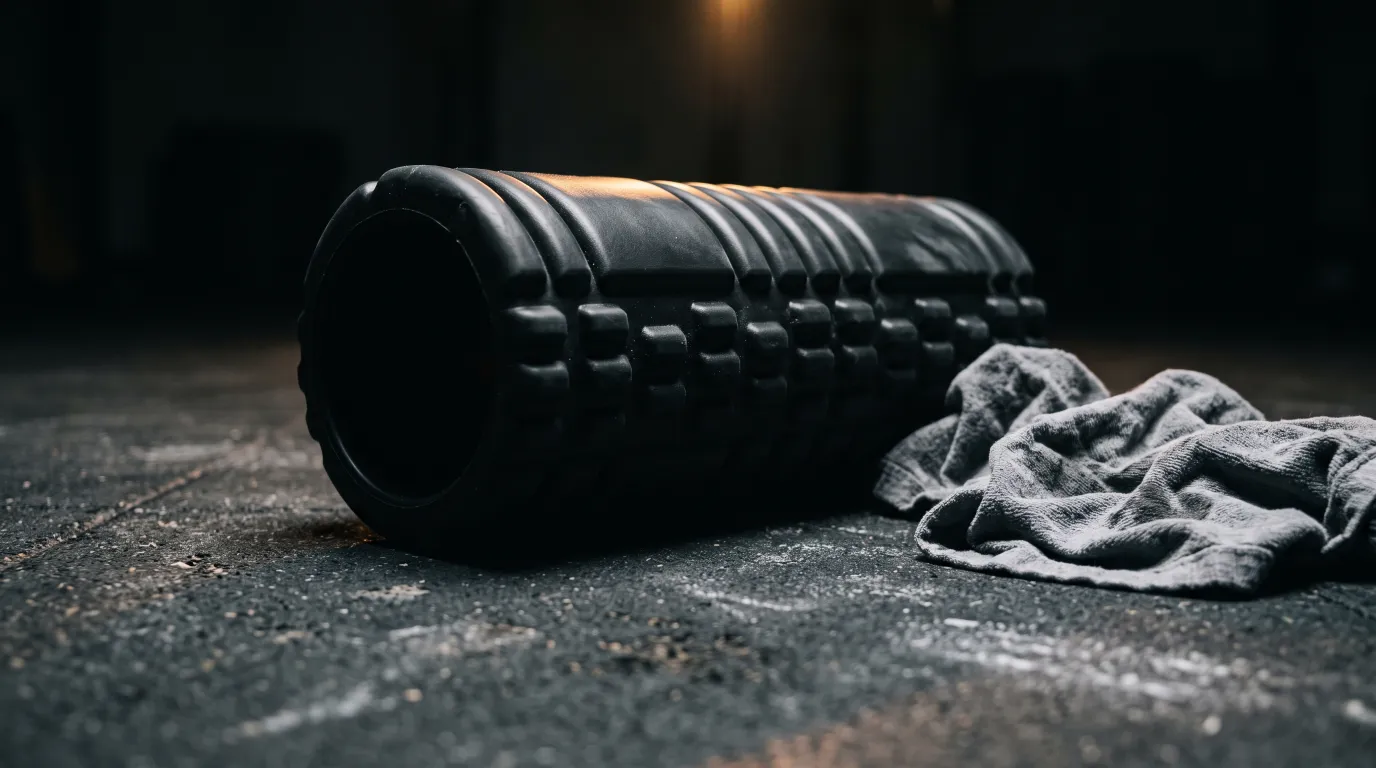
Foam rolling occupies an odd position: almost universally practised, almost universally justified with claims that don't hold up. That combination usually means the practice is useless. In this case it doesn't.
The effects are real. They're just smaller, shorter and mechanistically different from what the person who sold you the roller said.
What it reliably does
Two things show up consistently. First, rolling a muscle group increases the range of motion at the joints it crosses in the minutes afterwards — and unlike a long static stretch, it does this without a measurable cost to force production. That combination is genuinely useful, because it means you can use it immediately before lifting.
Second, rolling after hard training reduces how sore you feel in the following days, and there's some evidence it blunts the drop in performance that soreness usually brings. Note the wording. It reduces the perception of soreness. That is a real benefit — you train better when you feel less battered — but it isn't the same as repairing the muscle faster.
The most likely explanation for both is neural rather than structural: pressure and movement change what the nervous system will allow, and it turns the guarding down. Which is also why the effect is short-lived.
There's a third benefit that never gets mentioned because it isn't physiological. Ten minutes on a roller is ten minutes of deciding to train, in the room where training happens, before anything hard has been asked of you. On day nineteen that is not a trivial function.
What it doesn't do
It doesn't break up adhesions or release fascia. The forces required to deform dense connective tissue are far beyond what a person can generate leaning on a cylinder, and the timescale of the effect — arriving in seconds, gone within an hour — is wrong for a structural change to tissue.
It doesn't flush toxins. There are no toxins. That phrase entered fitness vocabulary from nowhere in particular and has never had a referent.
It doesn't lengthen muscles, fix a knee that hurts, or substitute for strength through range. And the range-of-motion gain fades — which is fine if you use it as a doorway into training, and useless if you roll and then sit down.
“It changes what your nervous system will let you do for the next twenty minutes. Use the twenty minutes.”
Why the story matters
Because the wrong mechanism produces the wrong technique. If you believe you're breaking down adhesions, you grind on one spot as hard as you can bear for several minutes, and the discomfort feels like evidence of work being done.
If you believe it's a nervous-system effect, you roll at a tolerable pressure, keep moving, and follow it immediately with the movement you're trying to improve. The second version is both more pleasant and better supported.
The mechanism also tells you when to do it. A structural change would keep working all week and you could roll whenever suited you. A neural change lasts minutes, which means rolling on the sofa at 9pm buys you almost nothing, and rolling ninety seconds before your first squat set buys you the whole effect.
It tells you what not to expect, too. If you've rolled the same knotted spot in your upper back every day for a month and it's still there, that isn't a failure of pressure or persistence. It's evidence that pressure was never the right tool for whatever that is.
How to spend ten minutes
Ten minutes covers all of that comfortably. If you find yourself spending thirty, that's thirty minutes not spent on the things that decide the month — the training, the protein target and the step count.
The equipment question has a short answer too. A standard smooth roller does everything described here. The knobbly ones, the vibrating ones and the ones with a heating element are not better supported by evidence, they're better supported by margin. Buy the cheap one.
Active Recovery days are the obvious home for the longer version, and that's where the program puts it — alongside the walk and the slower stretching. But the higher-value slot is the ninety seconds before training on every other day, because that's where the short-lived effect actually gets spent on something.
- Roll before training as a doorway, not after training as a repair job. Thirty to sixty seconds per area is plenty
- Follow every rolled area immediately with the movement it feeds — quads then bodyweight squats, calves then ankle rocks
- Keep the pressure at a level you can breathe through. Grinding a spot until your eyes water isn't a stronger dose
- Prioritise quads, glutes, calves and mid-back. These are the four that limit the program's main lifts
- On Active Recovery days, use it as a lead-in to the walk and the longer stretching rather than as the session itself
The one caution
Don't roll directly on a joint, over a bony area, or on something that is sharply painful rather than tender. Pressure on a spot that hurts in a specific, localised way is not treating anything, and it can make an irritated structure more irritated.
Numbness, tingling, swelling or pain that keeps getting worse is a reason to stop and speak to a clinician, not a reason to roll harder.
Sources
Written by Coach D — the voice of the certified personal trainers behind the SHRED30 system. Educational content, not medical or dietary advice.
Day 1 is free.
Go deeper: the free anatomy nutrition and strength & conditioning study guides teach the science under every article.